Sample size: 2514 observations
Mean return: 0.0575%
Std deviation: 1.1336%GARCH Models
Modeling volatility clustering
finance
time-series
volatility
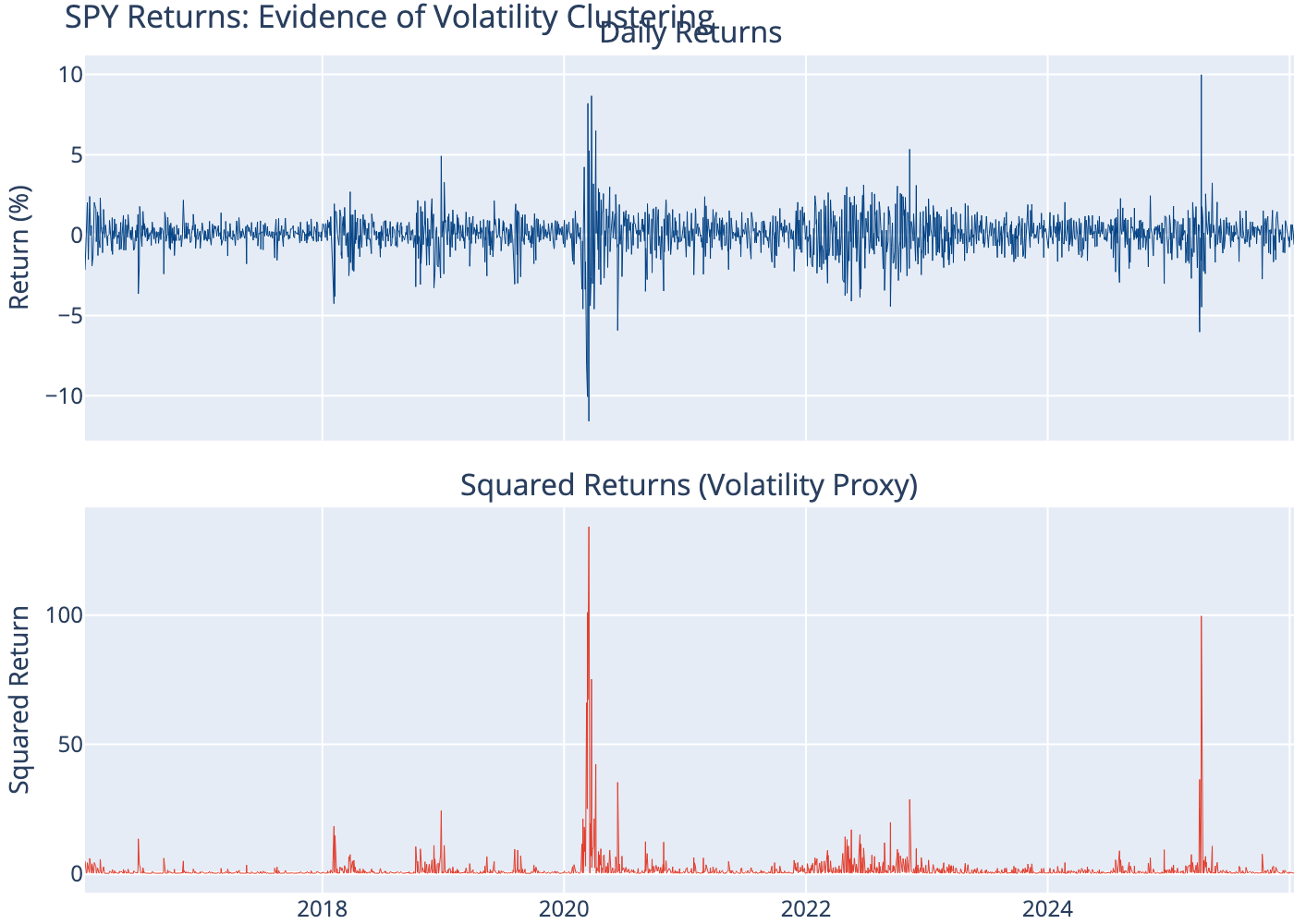
GARCH models capture volatility clustering—the tendency for large price moves to follow large moves and small moves to follow small moves.
1 Abstract
The Generalized Autoregressive Conditional Heteroskedasticity (GARCH) model, introduced by Bollerslev (1986), captures a key empirical feature of financial returns: volatility clustering. Large price movements tend to cluster together, as do small movements. GARCH models allow volatility to vary over time, improving risk forecasts and option pricing.
2 Volatility Clustering
Financial returns exhibit:
- Volatility clustering: High volatility periods followed by high volatility
- Fat tails: More extreme returns than normal distribution predicts
- Leverage effect: Negative returns often increase volatility more than positive returns
3 GARCH(1,1) Model
The standard GARCH(1,1) model:
Return equation: \[ r_t = \mu + \varepsilon_t, \quad \varepsilon_t = \sigma_t z_t, \quad z_t \sim N(0,1) \]
Variance equation: \[ \sigma_t^2 = \omega + \alpha \varepsilon_{t-1}^2 + \beta \sigma_{t-1}^2 \]
Where:
- \(\omega > 0\) = constant (base variance)
- \(\alpha \geq 0\) = ARCH coefficient (shock impact)
- \(\beta \geq 0\) = GARCH coefficient (persistence)
- \(\alpha + \beta < 1\) for stationarity
4 Interpretation
- \(\alpha\): How much recent shocks affect current volatility
- \(\beta\): How persistent volatility is over time
- \(\alpha + \beta\): Overall persistence (close to 1 = highly persistent)
- Long-run variance: \(\bar{\sigma}^2 = \frac{\omega}{1 - \alpha - \beta}\)
5 Compute (Python)
6 Evidence of Volatility Clustering
7 Fit GARCH(1,1) Model
                     Constant Mean - GARCH Model Results
==============================================================================
Dep. Variable:                  Close   R-squared:                       0.000
Mean Model:             Constant Mean   Adj. R-squared:                  0.000
Vol Model:                      GARCH   Log-Likelihood:               -3221.16
Distribution:                  Normal   AIC:                           6450.32
Method:            Maximum Likelihood   BIC:                           6473.63
                                        No. Observations:                 2514
Date:                Wed, Jan 14 2026   Df Residuals:                     2513
Time:                        21:46:56   Df Model:                            1
                                Mean Model
==========================================================================
                 coef    std err          t      P>|t|    95.0% Conf. Int.
--------------------------------------------------------------------------
mu             0.0914  1.464e-02      6.241  4.335e-10 [6.270e-02,  0.120]
                              Volatility Model
============================================================================
                 coef    std err          t      P>|t|      95.0% Conf. Int.
----------------------------------------------------------------------------
omega          0.0379  1.029e-02      3.684  2.295e-04 [1.775e-02,5.811e-02]
alpha[1]       0.1813  3.032e-02      5.979  2.249e-09     [  0.122,  0.241]
beta[1]        0.7899  2.973e-02     26.572 1.447e-155     [  0.732,  0.848]
============================================================================

Covariance estimator: robust
8 Extract Parameters
Long-run daily variance: 1.3172
Long-run annualized volatility: 18.22%| Parameter | Value | |
|---|---|---|
| 0 | μ (mean) | 0.091403 |
| 1 | ω (omega) | 0.037928 |
| 2 | α (alpha) | 0.181284 |
| 3 | β (beta) | 0.789923 |
| 4 | α + β | 0.971207 |
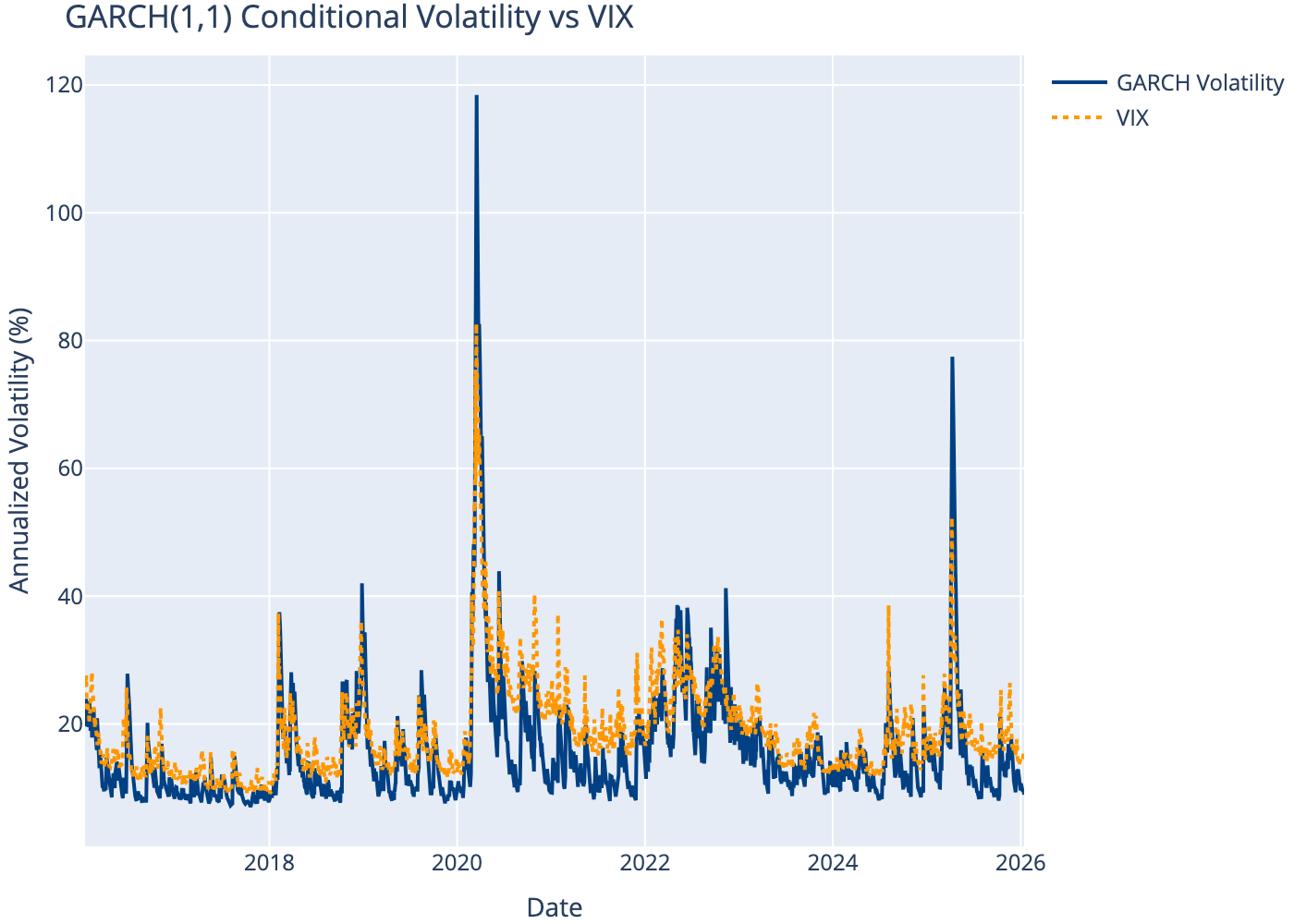
9 Conditional Volatility
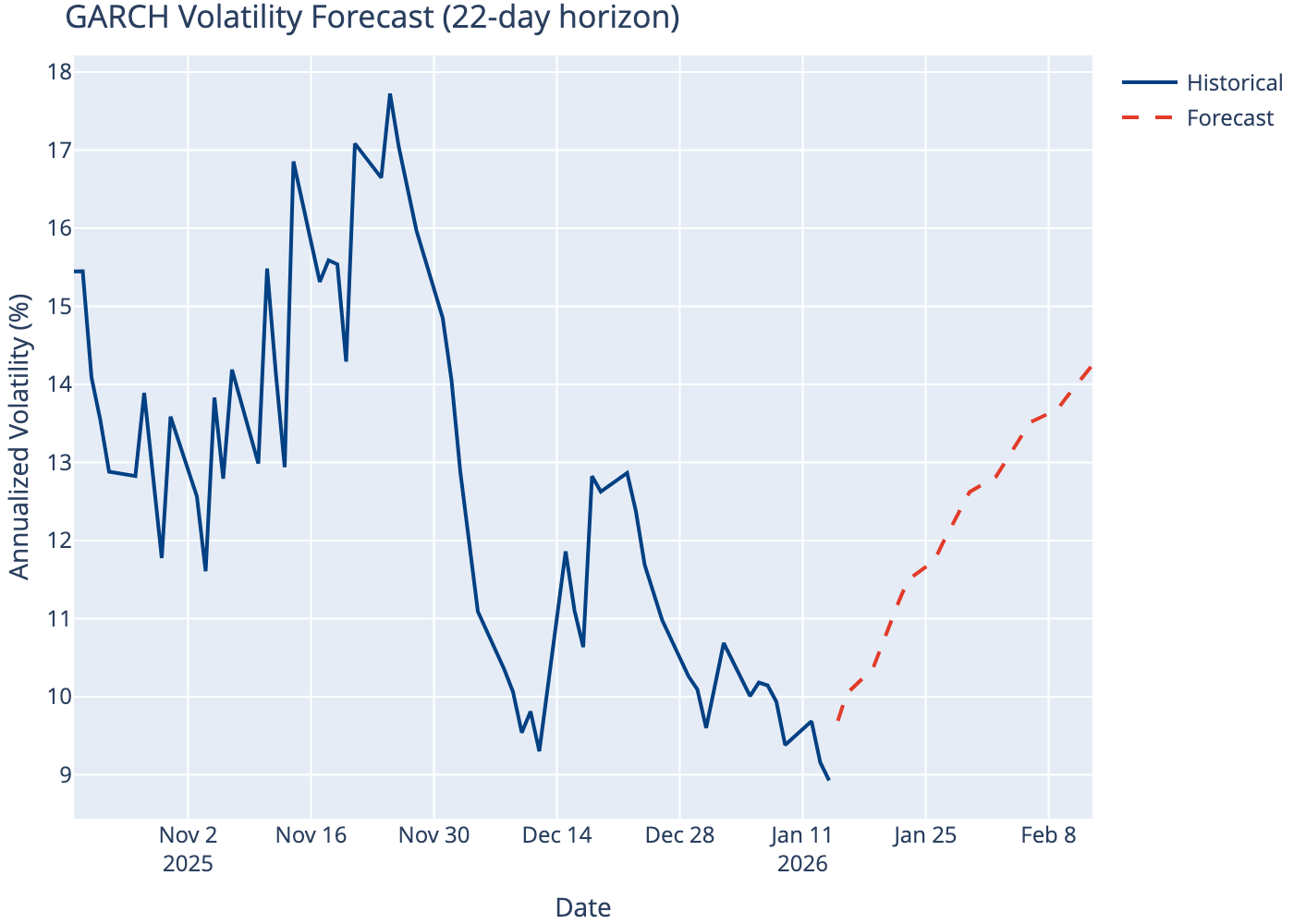
10 Volatility Forecast
11 Model Comparison
Compare different GARCH specifications.
| Model | Log-Likelihood | AIC | BIC | |
|---|---|---|---|---|
| 0 | GARCH(1,1) | -3221.16 | 6450.32 | 6473.63 |
| 1 | GARCH(2,1) | -3221.14 | 6452.29 | 6481.44 |
| 2 | EGARCH(1,1) | -3231.61 | 6471.23 | 6494.55 |
| 3 | GJR-GARCH(1,1) | -3189.03 | 6388.06 | 6417.20 |
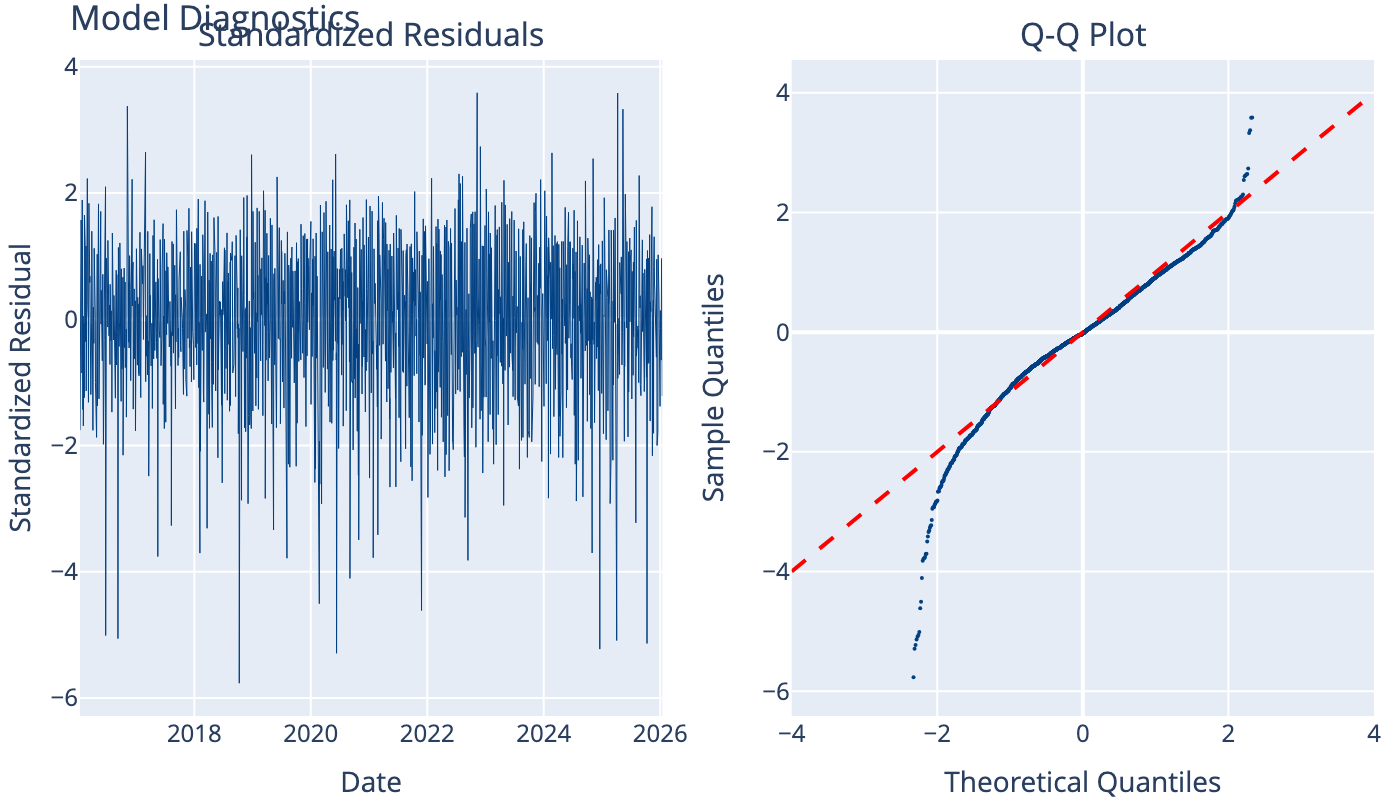
12 Standardized Residuals
Check if the model captures volatility dynamics properly.
13 Applications
- Value at Risk (VaR): Time-varying volatility improves risk estimates
- Option Pricing: Better volatility forecasts improve pricing
- Portfolio Optimization: Dynamic allocation based on volatility regimes
- Trading: Volatility mean reversion strategies
14 Conclusion
GARCH models capture the empirical reality that volatility is not constant but varies predictably over time. The GARCH(1,1) model is often sufficient for most applications, with extensions like EGARCH and GJR-GARCH capturing additional features like the leverage effect. Volatility forecasts from GARCH models are widely used in risk management, option pricing, and trading strategies.